The Epidemiology of Human Insecurity: Measuring Quality of Life from Rural Disparity to Active Conflict
I am working on a case study regarding poverty. In this research, I am considering: Quality of Life (QoL), Life Expectancy (LE), Access to resources, and additional factors. As a regional comparison, I am curious how QoL and LE varies due to contributing factors such as barriers to accessing basic needs resources and extreme factors like genocide and/ or political violence.
Regions for this ongoing study: Southern Appalachia, East TN, USA, Central Region of Uganda, and Gaza, Palestine.
Research Question: "How do variances in life expectancy and quality of life correlate with the spectrum of human insecurity, ranging from chronic, structural resource barriers in stable regions to acute, state-sanctioned violence and geopolitical crises?"
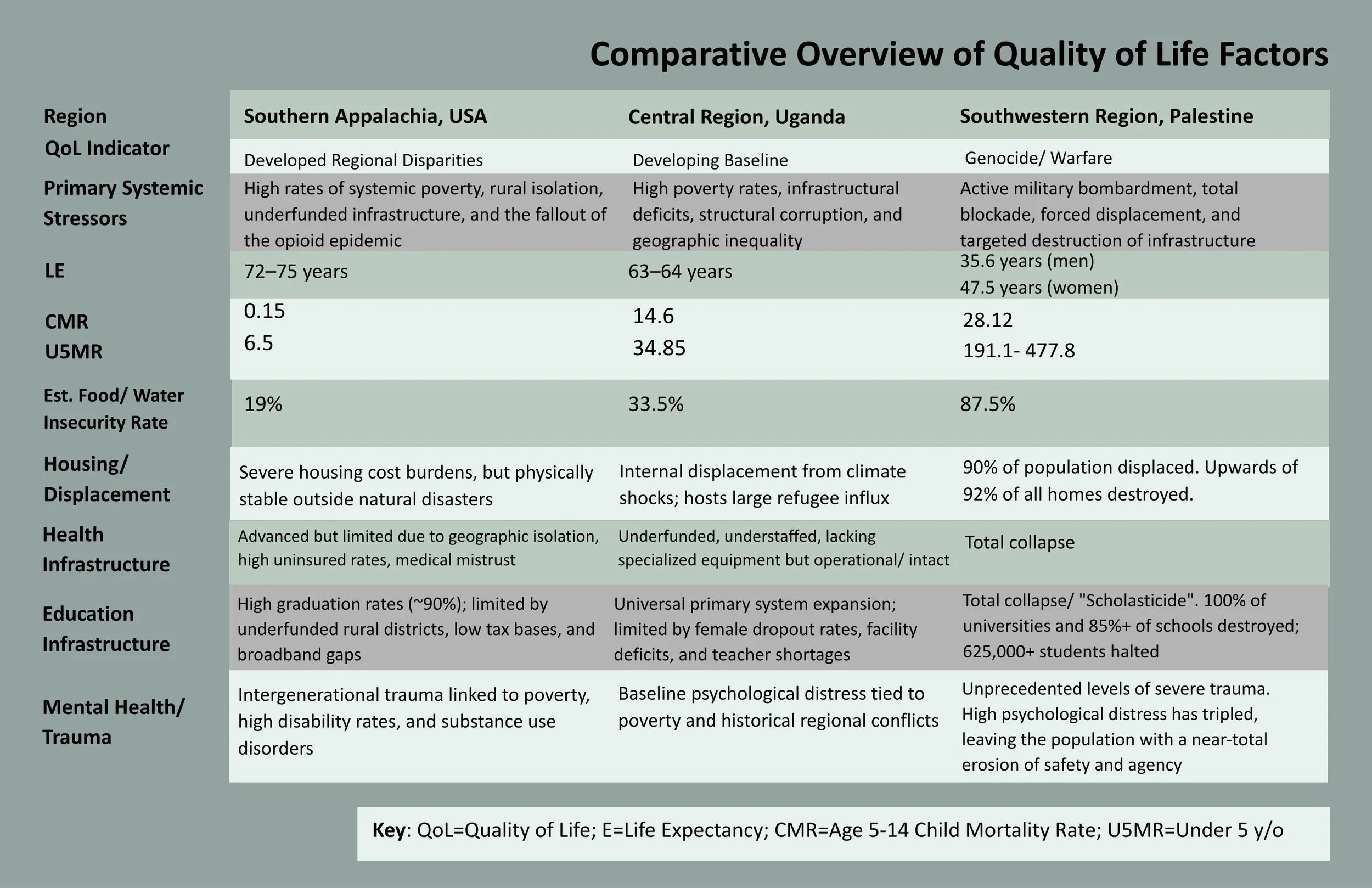
Chart Created by: Alicia M. Bynum | 2026
*Please note, while this research project and ideas are my own, I have sourced: Google. (2026). Gemini (Large language model). google.com to help gather and synthesize data comparisons among “Overview of Quality of Life Factors.”
The baseline of human insecurity begins as an internal fracture within a wealthy nation, as demonstrated by Southern Appalachia and East Tennessee. In this environment, life expectancy is shorter than the U.S. national average, lingering between 72 to 75 years, and remains heavily dictated by local zip codes. While public infrastructure ensures secure municipal tap water, severe socioeconomic gaps result in a 18.7% food insecurity rate across Northeast Tennessee. Advanced healthcare systems are physically present but frequently rendered inaccessible by geographic isolation, high uninsured rates, and deep-seated medical mistrust. Low-wage earners simultaneously bear severe housing cost burdens, while the community navigates a heavy baseline of intergenerational trauma inextricably linked to systemic poverty, disability, and the local fallout of the opioid epidemic.
This landscape shifts from localized disparity into a broader, systemic challenge when examining a developing nation baseline like Uganda. Here, life expectancy is stable but low, averaging 63 to 64 years due to pervasive poverty and a high prevalence of preventable infectious diseases. Unlike the secure utility grids of East Tennessee, Uganda faces deep chronic infrastructure deficits; 30% of the entire population completely lacks basic access to safe water sources, and local food security remains highly vulnerable to climate shocks and inflation. The country's healthcare system operates under chronic shortages of staff, funding, and specialized equipment, forcing rural populations to travel long distances for care. Furthermore, internal displacement occurs frequently due to regional environmental shocks, and the population carries the psychological weight of chronic poverty alongside the historical trauma of regional conflicts.
The scale of human suffering breaks away from these developmental baselines entirely when observing the catastrophic crisis in Palestine and the Gaza Strip. Driven by intense military bombardment and a total blockade, life expectancy has collapsed vertically to an unprecedented 35.6 years for men and 47.5 years for women. Starvation and dehydration are systematically deployed as weapons of war, forcing 75% of the population to consume highly contaminated water while over 85% of youth face acute water insecurity. The healthcare apparatus has suffered a total collapse, with systematic targeting and a denial of basic medical shipments leaving nearly all hospitals completely inoperable. Survival is further constrained by the physical displacement of 90% of the population and the destruction of up to 92% of all residential structures. This continuous exposure to mass violence has caused severe psychological trauma to triple, creating a total erosion of human safety and agency.
Some Early Key Findings:
In a developed, stable environment like East Tennessee, the mortality line plummets almost to zero (0.15) once children pass the age of five because infrastructure and modern medicine shield them from disease (CDC).
The fact that Palestine's CMR spikes all the way to 28.12 shows that a child aged 5–14 in Gaza faces nearly the same level of mortality threat as an infant born into a developing nation with structural poverty like Uganda (34.85) (Uganda (UGA) - Demographics, Health & Infant Mortality - UNICEF DATA, Two Years of the Gaza War in Three Health Charts | Think Global Health).
While structural resource barriers limit survival metrics in East Tennessee and Uganda, the catastrophic spike to 191.1 to 477.8 deaths per 1,000 live births in Palestine is driven entirely by blockade-induced famine, infrastructure collapse, and extreme state-sanctioned political violence.
When viewed through a public health lens for "The Epidemiology of Human Insecurity: Measuring Quality of Life from Rural Disparity to Active Conflict," we can infer profound epidemiological similarities about poverty across these three separate continents. Rather than just a lack of financial capital, poverty acts as the primary "upstream" driver that directly dictates whether a human population maintains resilience or experiences structural health collapse. Whether observed within a wealthy nation, a developing country, or an active conflict zone, poverty operates under the exact same public health law: it functions as a pre-existing exposure that strips away a population’s physiological buffers, ensuring that the most socioeconomically marginalized communities consistently absorb the heaviest burden of disease, trauma, and premature mortality (Childhood mortality during Gaza genocide in 2024, Leading Causes of Death - FastStats - CDC, Uganda - Health Country Profile | Our World in Data).
The most glaring intersection across these three regions is the direct, structural erosion of "survival infrastructure,” specifically the biological access to food, water, and healthcare. The 18.7% food insecurity rate in Northeast Tennessee, the 30% lack of basic clean water grids in Uganda, and the catastrophic, weaponized famine in Gaza all target the exact same fundamental human vulnerabilities (Northeast Tennessee Food Security Profile, Uganda). Whether this vital infrastructure is restricted due to corporate and economic disinvestment (Appalachia), macro-economic underdevelopment (Uganda), or active, military erasure (Palestine), the biological outcome remains identical. Human bodies are subjected to severe, concentrated environmental stress because their immediate socioeconomic environment cannot guarantee or protect basic daily nutrition, stable housing, or life-saving clinical interventions.
Furthermore, poverty across these three continents enforces a state of severe geographic captivity and intergenerational trauma that permanently damages population health. The geographic isolation and "food deserts" trapping rural Appalachians mirror the steep transit barriers facing rural Ugandans and the absolute, physical blockade enclosing the population of Gaza. This lack of physical and economic mobility traps individuals inside high-risk environments where escape from localized health hazards is impossible. Over time, this chronic entrapment manifests as deep psychological distress, ranging from Appalachian "deaths of despair" and “romanticizing resilience” to the historical scars of regional conflict in Uganda and the unprecedented psychiatric erosion in Palestine, proving that the trauma of poverty alters population neurobiology and passes its health defects down to future generations (Leading Causes of Death - FastStats - CDC).
